Showing posts with label peach trees. Show all posts

Thursday, May 30, 2013

To Pick a Peach!


It's that time again. Our old Desert Gold is the first tree in the orchard to ripen. She is the first peach tree that we planted 16 years ago. It was this tree that made us realize the incredible abundance that peach trees give us, we knew that we'd have enough peaches to share with our neighbors.
 The May Pride, FlordaPrince and Tropic Snow ripen next, followed by a few more weeks of waiting. By the end of June the Mid Pride turns and in late July the August Pride Peach Tree ends the season.
   
 Early each morning my husband and I take our boxes and buckets to the orchard to harvest the ripe peaches. We climb the ladders and feel our way through the branches to reach the peaches, touching each one to feel for that slight give in the peach.
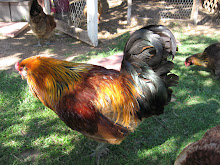
The chickens wait for the bird-pecked, damaged peaches. Charlotte and Samba the goat girls wait for a few treats too!
It's cool and quiet and peaceful in the early morning garden.
Sorting the good ones...
and tasting to make sure they are ready!

Charlotte, watching and waiting to be taken to the pasture/alley where she grazes with Samba.


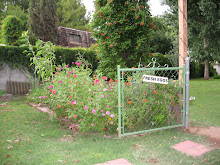
We love that we're able to provide sweet, organic peaches for our neighbors to enjoy. Our orchard is small and secluded in our backyard, our neighbors would never know it was there except for the 'Organic Peach' sign that sits on our curbside every year at peach harvest time. We work hard all year to keep our fruit  trees pruned and fertilized and healthy. It's worth the trouble as mothers with their babies on their bikes and people walking their dogs stop and talk and take a bite of our juicy peaches.
  We hope that it's just the beginning of the change we would like to see in the way we eat. It's time for our communities to take care of one another, we think this is a good way to start!

Wednesday, March 14, 2012

Plant a Fruit Tree!

I'll never forget the first year that our Desert Gold peach tree was heavy with fruit! I realized then that planting a fruit tree is one of the easiest and most practical ways to start your own edible garden. Besides, there's nothing better than a warm, tree ripened peach!
Here in the Phoenix area, we plant our bare root fruit trees in the Spring, that means late December or early January. By mid March the bare-root trees at our local nurseries have been potted or containerized and are ready to bud. The sooner you get them in the ground the better. Here's what you do! Find a nice sunny location. If you are planning on keeping your tree small, which is what backyard orchard culture is all about, think about how tall you want your tree to grow. The best advice that I have heard is, "if you stand on a small step ladder and reach up at arms length, that's how tall you want your tree to grow. No higher!"  If your property is small turn your tree into a shrub or hedge. 
Now, start digging. I like to dig the hole a few days before the actual planting, that way you can fill the hole with water to check for drainage (we do this a couple of times). Fill the hole with water in the evening, make sure it has drained by morning, and you are good to go. Drainage is really important, you don't want your tree sitting in water!  Dig a hole about twice as wide as and no deeper than the root ball.You want the roots to fit nicely, no crowding or bending.  Make sure you let the soil dry out before you begin to dig again, or you'll have big dirt clods and damage the soil structure.


As you dig, slope the sides outward at the top. We take a shovel and score all around the sides, if the soil is really hard ( in Arizona it is!), we use a heavy bar to break up the clay like dirt. This makes it easier for the roots to penetrate as they grow down and outward. We make a mixture of mulch, or organic matter, a few hand fulls of sand and bone meal and add it to some of the native soil.We put this in the bottom of the hole.
Next, cut down the side of the pot, and gently slip the bottom out from under the container. I didn't get a photo of this part because I had to help hubby hold it together. This is really a two person job! You can then place the whole container into the hole. This holds the contents and roots a little more secure, and it causes less stress to the root system, otherwise it easily falls apart. At this point, start to refill around the pot with the original soil that you have taken from the hole. We throw a few hand fulls of mulch in as we fill.

As you fill in around the container, gently lift it out of the hole. Continue filling in around the root ball and as you do hold the tree straight and tall. It should sit in the hole at about the same level it grew in the pot. The top of the root ball should sit 1 to 2 inches above the ground. Make sure the bud union is well above the soil level. Tamp the soil down as you fill, adjusting the tree as you go. 
Keep filling until you get the hole filled in. Pack down to prevent air pockets. 
 Build a nice basin around the tree to hold the water. As the tree grows, extend this basin outward in a circle in a radius equal to the trees height. You want the roots to reach and grow outward, just like the top of the tree.Put a top dressing  around the base of the tree to help retain moisture and keep it weed free. You can use, straw, compost or mulch.
Give the tree a deep watering, fill the basin a couple of times to give it a good start. Always water slowly and deeply to a depth of  two feet, deeper as it matures.  Make sure the roots don't dry completely out, (don't drown it either!). You will have to keep an eye on the tree for a few weeks until the root system gets established. 

After planting, prune your tree ( our peach tree hasn't had it's first pruning in this photo). This helps to establish a balance between the branches and the roots. Stand back and look at your new tree. Think about the size of your tree. If you prune your tree knee height, it will force new branches to form just below the new cut. Later you can choose the best three or four most evenly spaced branches, they will become your main branches or the scaffold branches. If the new tree already has evenly spaced branches, I usually prune less off the tree and use the existing branches. Make sure you prune where there is an outward facing bud. That's the direction that your new branch will grow. Remove all of the smaller shoots. Choose the branches that are more horizontal than vertical. Don't be afraid to prune as the tree grows.
My favorite place to visit when I want to review planting, pruning and other backyard orchard culture techniques is the Dave Wilson's website. Here, is an excellent video on how to prune a fruit tree.

 The best place to find local, organic food can be just steps from your own back door! Fruit trees take a little time and commitment , but it is well worth the effort. Besides, it's the perfect way to eat!

Linked up with The Prarie Homestead here!

Saturday, September 10, 2011

Mulch Wide, Water Deep ... Keeping your Home Orchard Healthy.

When we planted our first peach tree, we had no idea that just one tree could provide us with so much bounty and beauty. If you want to turn your property into a edible garden, fruit trees are an excellent way to start.
 Peach trees grow unbelievably fast and produce an amazing amount of fruit. They deserve and require more pruning and nurturing than the other fruit in our orchard. During the late summer months, before the busy fall planting time, we spend some of our evening hours mulching around the root zone of our fruit trees. Here are some before and after photos of the process.  
Here's a good photo showing how the top soil is dry and needs to be worked. But, beneath it, there is rich, dark soil from previous years of layering the mulch.
Mulching and watering are especially important for the tree's first year. The root system or root ball is still shallow and will dry out quickly in our hot summer heat. Our desert soil can easily turn to clay, preventing water from absorbing evenly. As the tree matures, and with proper watering, the roots will eventually spread wide and deep.  Mulching aids with watering, it helps retain moisture and keeps the weeds  under control. We add some of our coarsely decayed compost around the base of the young tree, being careful not to till too deeply and disturb the shallow roots. This compost eventually breaks down, adding organic matter to the soil, feeding the tree. We are lucky to have flood irrigation in our neighborhood, this means every two weeks our trees are flooded with at least twelve inches of water. That's a good, deep watering that I am sure our trees love and that I am immensely thankful for!

This Desert Gold Peach is next in line for it's organic mulch treatment!
         

Love this illustration showing the amazing root system of a tree!

This tree is mulched out to the drip line of the tree, if possible extend it even wider.
Organic compost (chicken poop, coffee grounds, leaves, grass clippings, and other organic matter).

 As the tree grows, gradually extend the well and the mulch beyond the canopy of the tree so the water reaches the feeder roots. This means, as the trees grows you should move your watering components( drip system or hose) outward away from the trunk of the tree. With each watering, the water should reach a depth of at least 3 feet. Deep watering also washes the harmful salts below the root zone.
 We use a water probe to check our depth. The probe will move through the soil until it gets the dry, hard soil and then it will stop.
.
Don't drown your trees either, make sure you let the soil dry out  between watering.

Hubby and I are good at multi-tasking. We mulch, turn and water and I almost always have  loppers in my hands for unruly branches! Summer pruning is an endless task!

Our demonstration tree is a 1st year Pink Lady apple. Looking at the photos, we probably need to extend our well out another 12 to 14 inches very soon. 
Take a look at the excellent sites below, they show and tell more detailed information about the root system of a tree. It's nice to know what's going on below the surface! I consider this information, essential knowledge for the home orchardist!  http://www.sustland.umn.edu/implement/trees_turf.html

Stop by An Oregon Cottage, we love what they have to say!

Friday, February 18, 2011

The Blossoming Time of Year

The buds on my espaliered apples and my May Pride peach tree are the first to wake to the warm Spring sun. Walking through my orchard this morning reminded me of a favorite poem from my grade school days. It seem appropriate to share it with you on this beautiful Spring day.


I sit in the shadow of apple-boughs,
In the fragrant orchard close,
And around me floats the
scented air,
With its wave-like tidal flows.
I close my eyes in a dreamy bliss,
And call no king my peer;
For is not this the rare, sweet time,
The blossoming time of the year?


I lie on a couch of downy grass,
With delicate blossoms strewn, 
And I feel the throb of Nature's heart,
Responsive to my own.
Oh, the world is fair,
and God is good,
That maketh life so dear;
For is not this the rare, sweet time,
The blossoming time of the year?


I can see, through the rifts of the apple-boughs, The delicate blue of the sky, And the changing clouds with their marvelous tints
That drift so lazily by.
And strange, sweet thoughts sing through my brain,
And Heaven, it seemeth near; 
Oh, is it not a rare, sweet time,
The blossoming time of the year?

Horatio Alger